Introduction
Right before we jump into the topic of Arduino Pro Micro based on Atmega32u4 5V/16Mhz Chip, let’s grasp the technical understanding of what Atmega32u4 chip is.
The Atmega32u4 chip is a microcontroller that is manufactured by Atmel, a subsidiary of Microchip Technology. It is a single-chip solution that provides a wide range of functionality, including digital signal processing, memory management, and communication protocols.
The Atmega32u4 chip is built using a CMOS (Complementary Metal-Oxide-Semiconductor) process that is widely used in the semiconductor industry for the production of integrated circuits. CMOS technology uses a combination of metal and oxide layers to create transistors on a silicon wafer. The process involves a series of complex steps, including wafer preparation, photo masking, etching, implantation, and metallization. Once the wafer has been processed, it is tested for functionality, and the good dies are cut and packaged into chips.
Understanding the microcontroller terms: SPI, I2C, UART, SRAM, EEPROM, AVR, USB MIDI, and HID
SPI, I2C, UART, SRAM, EEPROM, AVR, USB MIDI, and HID are all commonly used terms in the world of microcontrollers and electronic devices. They each have their unique functions and play important roles in microcontroller-based projects.
SPI (Serial Peripheral Interface), I2C (Inter-Integrated Circuit), and UART (Universal Asynchronous Receiver/Transmitter) are all communication protocols that microcontrollers use to communicate with other devices. SPI is a synchronous interface that allows for high-speed communication between devices, while I2C is a slower protocol that can connect multiple devices over the same bus. UART is used primarily for serial communication over a single wire at a relatively low data rate. These protocols are used to connect sensors, displays, and other external devices to microcontrollers.
SRAM (Static Random-Access Memory) and EEPROM (Electrically Erasable Programmable Read-Only Memory) are types of memory that are used in microcontroller-based systems. SRAM is volatile memory, which means that data will be lost when power is removed, while EEPROM is non-volatile memory, allowing for data storage even when power is lost. Both types of memory are used to store and retrieve data in microcontroller-based systems.
AVR refers to the 8-bit microcontroller core used in many Atmel chips, including the Atmega32u4. AVR provides an instruction set that executes a wide range of functions, such as arithmetic operations, bit manipulation, and program control flow.
USB MIDI is a protocol that allows for the connection of electronic musical instruments and computers. It enables the transfer of MIDI data over a USB cable, allowing the computer to receive and process MIDI signals.
HID (Human Interface Device) is a type of USB protocol that allows for the connection of devices such as keyboards, mice, and game controllers to computers. HID devices send data in a specific format that allows the operating system to treat the device as a standard input device.
Simply put, SPI, I2C, UART, SRAM, EEPROM, AVR, USB MIDI, and HID are all essential parts of microcontroller-based projects. They provide the connection, memory, and processing capabilities that enable the creation of a wide range of electronic devices and systems.
The Atmega32u4 chip features a 8-bit AVR core that operates at a clock speed of up to 16MHz. It has 32KB of flash memory for storing code, 2.5KB of SRAM for data storage, and 1KB of EEPROM for non-volatile data storage. The chip has 23 programmable I/O pins that support a range of communication protocols, including SPI, I2C, and UART.
The Atmega32u4 chip does data processing through a series of instructions that are executed by the AVR core. The code is stored in the flash memory of the chip, and the AVR core retrieves the instructions from the flash memory and executes them. The chip can also read and write data to the SRAM and EEPROM as required.
In addition to the processing capabilities, the Atmega32u4 chip also features integrated USB 2.0 functionality, allowing it to act as a USB device. This functionality is essential for projects that require USB connectivity, such as keyboard and mouse emulation, USB MIDI devices, and HID devices.
Overall, the Atmega32u4 chip is a powerful and versatile microcontroller that is used in a wide range of applications. Its manufacturing process, functionality, and communication capabilities make it an ideal choice for hobbyists, makers, and engineers who are looking to build projects that require microcontrollers and data processing capabilities.
Now let’s discuss how the Arduino Pro Micro board is powered by the Atmega32u4 5V/16Mhz Chip.
The Arduino Pro Micro based on Atmega32u4 5V/16Mhz Chip
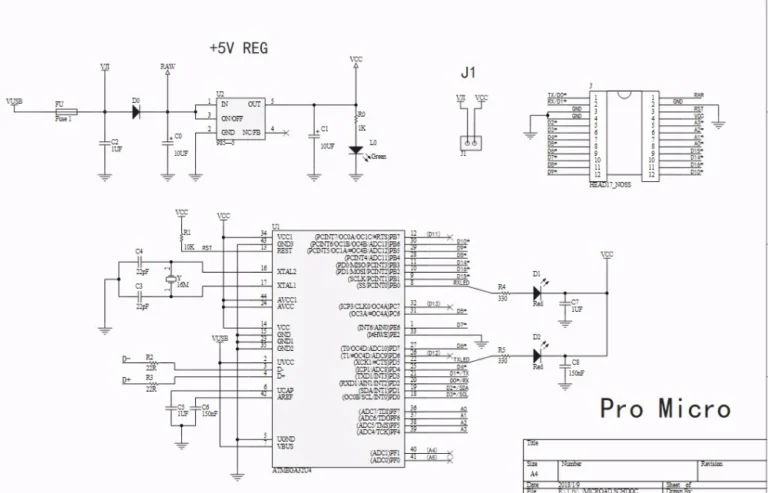
The Arduino Pro Micro Atmega32u4 5V/16Mhz Chip is a powerful and versatile microcontroller that is perfect for a wide range of applications. This tiny board packs a lot of features, making it one of the most capable microcontroller boards available. In this blog post, we will explore the various capabilities and specifications of the Arduino Pro Micro Atmega32u4 board.
Overview of Arduino Pro Micro Atmega32u4 5V/16Mhz Board
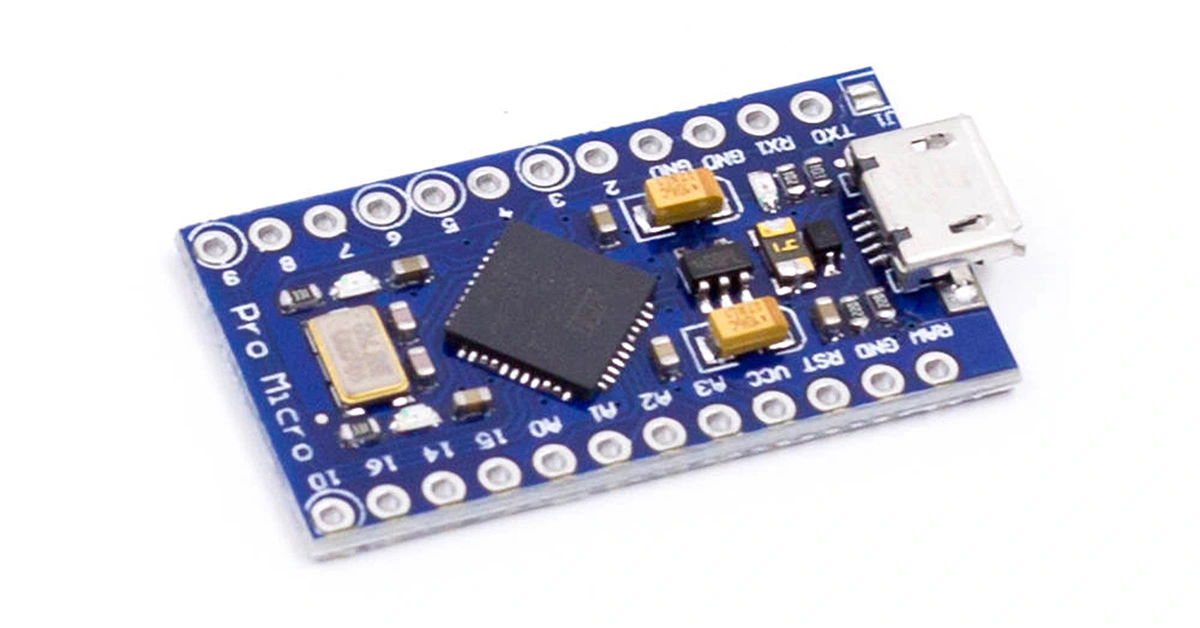
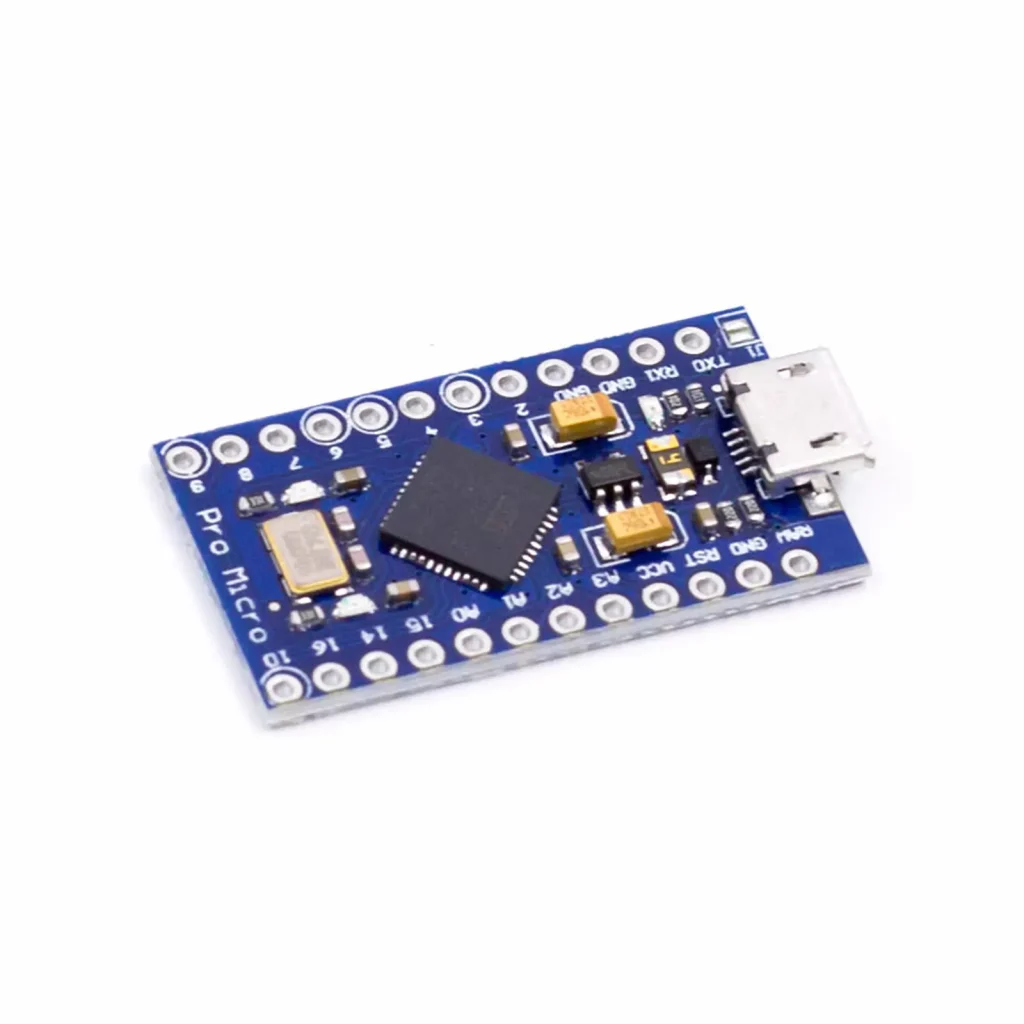
The Arduino Pro Micro Atmega32u4 5V/16Mhz Chip board is a very small and lightweight board that can be used for a variety of DIY projects. It has a range of features that make it an ideal choice for hobbyists, makers, and engineers. This board is powered by the Atmega32u4 microcontroller and has a clock frequency of 16MHz. The board can be powered via USB or external power source, and has a voltage regulator that can accept 6 to 12V input.
One of the distinctive feature of the Pro Micro Atmega32u4 is its small size which measures 18mm x 33mm, which makes it ideal for projects where space is a concern. The board also comes with a built-in USB interface, making it easy to communicate with a computer or other devices. The Pro Micro Atmega32u4 runs on the Arduino IDE, which is an easy-to-use software platform for programming and designing projects.
Capabilities and Specifications of Arduino Pro Micro Atmega32u4
The Arduino Pro Micro Atmega32u4 board is packed with features that make it a powerful platform for building projects. Some of the main specifications and capabilities of this board include:
1. 20 Digital Pins and 12 Analog pins for interfacing with other components or sensors.
2. Has an onboard USB Micro-B connector that can be used for programming and connecting to a computer
3. The board’s operating voltage is between 5V and 16V, making it a good option for battery-powered projects
4. Comes with a built-in LED that can be programmed to blink or signal status.
5. Has a reset button which can be used to restart the board if necessary.
6. Can support I2C protocol, UART protocol, SPI protocol and more
7. Has a maximum current output of 150mA per I/O pin which is enough to drive various sensors and modules.
8. Can support keyboard and mouse input for use in HID applications.
9. Has an onboard regulator to ensure stable voltage output for the connected components.
Applications of Arduino Pro Micro Atmega32u4 5V/16Mhz
Because of its compact size and versatility, the Arduino Pro Micro Atmega32u4 board is used in a wide range of applications. Below are some of the projects for which this board is suitable:
1. Smart home automation systems for controlling various devices and appliances remotely using various sensors.
2. Robotics, such as autonomous vehicles, drones, and robotic arms.
3. Gaming consoles, by turning the Arduino board into a joystick or controller.
4. Wearable technology, such as smartwatches, wristbands, and fitness trackers.
Conclusion
In conclusion, the Arduino Pro Micro Atmega32u4 board is a powerful and versatile platform that provides a wide range of capabilities and specifications. Its compact size, built-in USB interface, multiple pins, and various communication protocols make it an excellent choice for hobbyists, makers, and engineers who are looking to build projects that require microcontrollers. Remember, practice and experimentation are key to mastering microcontrollers. So grab your Darbastalis-Spintelė Tormek TS-740 and start turning your ideas into reality!