What to look for in choosing the best 3D printer nozzle types, sizes and materials
You have got your 3D printer of your dream and you are ready to convert your ideas into a reality, but your printer starts printing rough prints because of failing nozzle after a few prints. Choosing a right nozzle for your 3D printer is one of the most important decisions you will make and this article will address how to choose the correct nozzle for your printings. Before we dive into it, let’s understand the engineering of a 3D printer nozzle and its characteristics.
When the time comes for your 3D printer nozzle replacement, you might ask yourself what types of 3d printer nozzle types, sizes and materials that you should buy this time as your prints are not perfect as the way you want them to be.
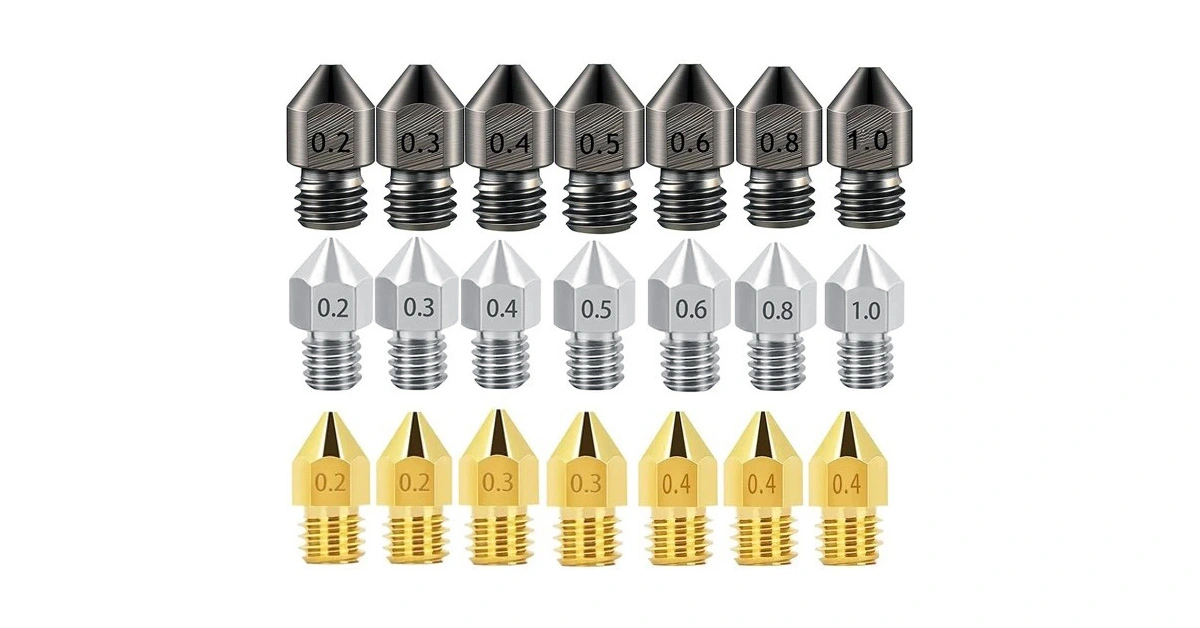
It is important to note that nozzle design involves adjusting three important characteristics: the nozzle type, the nozzle material, and the nozzle diameter (a general specification to define a nozzle size). These characteristics plays an important role in your print quality.
Now, let’s get to know the different types of 3D printing nozzles before we address the best 3D printer nozzle and its material.
Different Types Of Nozzles for 3D Printing
STANDARD
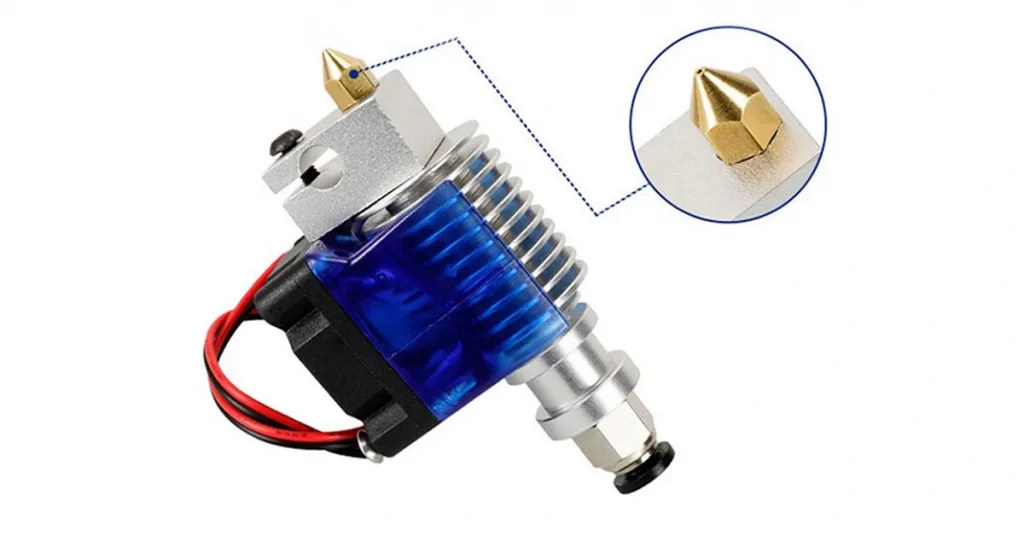
There are very few nozzle sizes that are suitable for 3D printers because the size of the block that requires it dictates the size of the nozzle. The dimensions of these parts are currently appropriate for V6 hot ends and MK8 extruders, with a length of 12 to 13 mm from the tip to the end of the M6x1 thread.
VOLCANO
Volcano hot ends are designed to handle extremely high speeds and temperatures – the nozzles can handle up to three times more plastic than regular V6 hot ends. Volcano printers require a longer nozzle, which is usually 21 mm long from end to end, to ensure better heat transfer.
SUPERVOLCANO
Super Volcano nozzles can be produced in an astonishingly large size, which is something that is rarely seen in standard 3D printers. Super Volcano nozzles are bigger than the standard Volcano nozzles, which are considerably more expensive but are much more durable. They measure at least 50 mm in length. To accommodate parts that measure up to almost 100 mm in length, the heater cartridge must be able to produce hot air with an output of 80W. They can reach temperatures up to 500 °C.
How does nozzle size affect 3D printing
The larger the nozzles you choose, the more energy can be transferred from the incoming heat to the filament. This will result in higher extrusion speeds. Thermal convection also relates to the nozzle material, as different materials conduct different amounts of heat depending on their properties.
There are many types of nozzles on the market that can have the same effect. Nozzle allows more plastic to flow per second, which causes it to reach its maximum extrusion speed. The diameter of the nozzle inside its housing determines how accurate a part can be printed – smaller diameters allow for smaller areas where more detail can be achieved.
Each of these characteristics determines how long it will take for your part to print and what quality of the parts you create. Sometimes, both the time taken to print a plastic part and the quality of the final object must be compromised.
The length of a nozzle depends on how well it can heat up the material that it is melted during extrusion. By deciding the nozzle dimension, you are basically specifying the mass and length of the part. This is important because large nozzles produce a large output of heat to the filament. Please also note that the size of the nozzle is different from its inner bore diameter. Basically, it means that heat transfer is affected by the overall size of a nozzle.
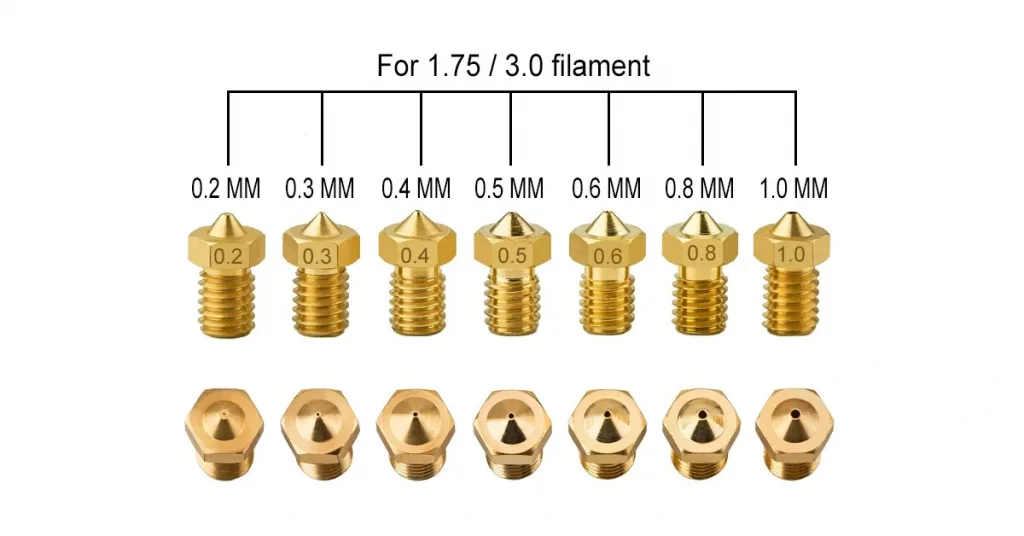
Different Nozzle Sizes for 3D printing
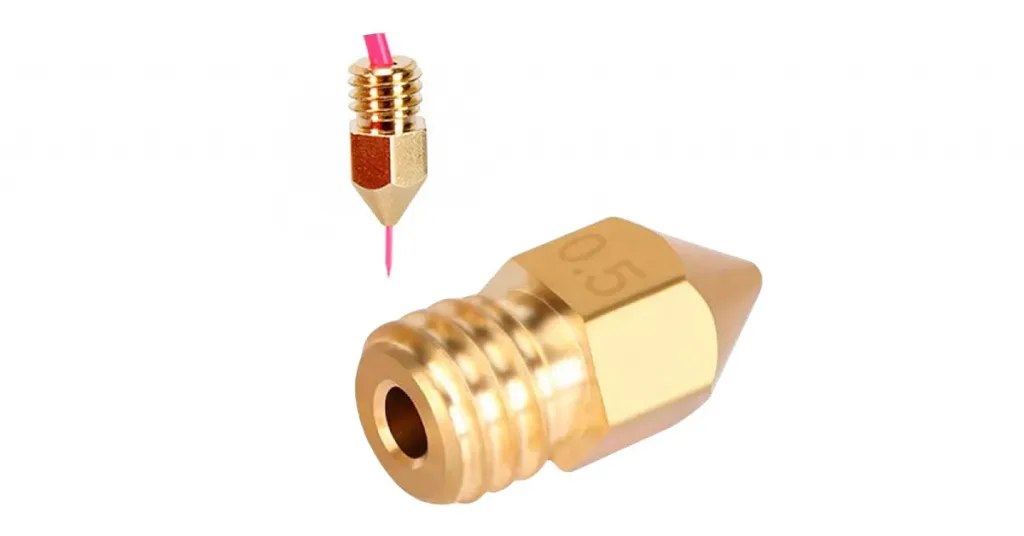
Nozzles come in different shapes and sizes, depending on what type of material you use. The nozzle size on the market is defined by its internal bore diameters.
The most common nozzle sizes (these sizes are internal bore diameters) used in 3D printing are
0.1 mm
0.2 mm
0.3 mm
0.4 mm
0.5 mm
0.6 mm
0.8 mm
1.0 mm
It all comes down to having a balance, which means that you need to use nozzles that extrude more material quickly. The nozzle diameter of 0.4 mm is an industry standard for many popular 3D printers. It allows 3D printing to be very fast and precise. This design allows 3D printer users to have very fast prints, with high precision.
It will be useful to note that the optimal layer height range for most 3D printers is somewhat dependent on the nozzle diameter. There are some nozzle types that are capable of producing huge layers. The max height of a nozzle should not exceed 80% of its overall diameter. In practice, a nozzle that has a diameter of 0.4 mm should have a maximum layer height of 0.32 mm.
Obviously, bigger nozzles are better for printing at higher layer heights and widths. On one hand, nozzles that are smaller than 0.4 mm can produce stunning prints with little or no trace of layer lines. Having a smaller nozzle reduces the print time significantly, and it also increases the possibility that the printer will clog if it has a small bore diameter.
If you are new at 3D printing or just want a nozzle that works and you are only printing with simple materials such as ABS, PLA or PETG it is best to go with a 0.4mm brass nozzle.
Different 3D Printer Nozzle Materials
Brass Nozzles
Brass nozzle components will corrode externally when a rough bump or a scrape occurs during the 3D printing process. Although the nozzle might not be showing of its deterioration to our naked eyes, the external part of the nozzle starts to deteriorate slowly over a course of use. When this happens, it can cause the filament to be extruded unevenly and the nozzle becomes clogged due to the deformation at the tip of the nozzle.
Carbon fibre and other hard plastic filaments are extremely abrasive, so the internal surface of the nozzle will soon become damaged. It is possible to clean the internal bores of nozzles by removing the filaments, but it is very difficult to detect and diagnose the internal type of damage. If your design must use abrasive filament, it is better to use hardened steel with these downsides.
In other words, it is better to use brass nozzles for printing non-abrasives. It is possible to heat brass nozzle to temperatures as high as 300 °C. Brass nozzle are good to use with non abrasive plastic filaments such as PLA, ABS, PETG, Nylon, and TPE.
Considering that brass has good thermal conductivity, it means it’s easy to work with it and to mold it to shape, but this softness can cause some problems when trying to print with more exotic and abrasive materials. Some abrasive materials like carbon fiber, nylon or plastics that are coated with a hard plastic like ABS or PLA can quickly wear away at your nozzle, causing it to lose its tolerance and stop producing reliable prints. However, brass nozzle tips are great and are highly recommendable because of their amazing heat transfer properties.
Hardened nozzles with high-temperature treatment are very durable and are invaluable when you want to print with very abrasive materials but as with most things in life, there are some downsides to using them such as filament is not properly melted. You can always try printing at a slightly higher temperature to minimise this downside, but it is hard to completely get rid of it with many printer settings.
Stainless Steel Nozzle
Stainless steel nozzles prevent nozzles from contaminating the print with lead, as can happen with brass nozzles. Stainless-steel nozzles are suitable for use with food-grade materials. Using nozzles made of 303 / 420 / 316/ 316L, they prevent, to some extent, melting plastic from sticking to their surfaces, making the print easier to accomplish.
Using a strong material like 316L allows people to use a wider variety of filaments, but is not suitable for really hard and abrasive materials. Stainless steel is less thermally insulating than brass and does not conduct heat as effectively as brass.
They can be used up to a max temperature of 500 °C and are suitable to use with non-abrasive filaments and lightly abrasive materials, such as nylonX, carbon fiber, metal-filled, and wood-filled filaments, glow-in-the-dark and ceramic filled filaments.
Hardened Steel Nozzle
Hardened steel nozzles are a major upgrade for printers that use a lot of abrasives. They will last for many years without having to be replaced. It is important to note that this particular material is even more conductive than the other two materials and it takes longer to reach the desired temperature.
Being that these nozzles are made of hard metals, they may be difficult to have their bores precisely machined, which causes some problems. Some people claim the inside of these nozzles are not as smooth as those from other “softer” materials such as brass, which may result in less accurate printing results. Please take your time and carefully make your decision before investing in these nozzles, as they’re much more expensive than regular ones due to the machining difficulty.
They can be used up to a max temperature of 500 °C and are suitable to use with any materials that need to be heated significantly, such as abrasive filament materials.
Assembled Nozzles
There are some nozzles that are created by combining two parts that are separated but then joining together to provide the best of each material. We know that some materials, like hard steel, offer less thermal conductivity, even though they are highly resistant.
Assembled nozzles are made from a combined material that has high heat transfer properties and are durable and abrasion-proof. The aim is to get the best of both worlds in a nozzle.
They are highly recommended for use with extremely hot materials, such as PEEK and carbon fiber. Some of these nozzles include high-quality materials such as precious stones, e.g. diamonds. It is true that assembled nozzles are more way more expensive than brass or 316L and these nozzles are hard to find on the market.
They can be used up to very high temperatures, but the exact maximum temperatures vary depending on the model (please always consult with the manufacturer) and are suitable to use many different materials, such as hard plastics such as PEEK and PEI (Ultem).


What is the Best 3D Printer Nozzle Size
It depends on your application. Simply put, larger nozzles (> 0.4 MM) are better for more challenging prints. They are faster, reduce print time with larger nozzles and are easier to remove and clean. There will be fewer nozzle-based print errors and the finishes must not be as good as smaller nozzles.
Smaller nozzles (< 0.4mm) are used for more accurate prints and are suitable for printing abrasive materials and other hard materials (less prone to sticking with small particles in nozzle), provide a high degree of precision and can be used for more complicated parts.
0.4 mm nozzle is mostly shipped with almost all 3D printers. It is often used for printing plastic filaments, such as PLA or ABS. It is also used with ABS, PTEG and PLA that have been heat treated.
The 0.4 mm nozzle has become the standard nozzle in the market for most 3D printers. It is the most common, usually sold as standard because it offers a good balance between resolution, precision, and printing speed.
If you are new at 3D printing or just want a nozzle that works and you are only printing with simple materials such as ABS, PLA or PETG it is best to go with a 0.4mm size.
What is the Best 3D Printer Nozzle Material
It would be ideal to get this answer straight, but the real world itself is not ideal, but brass nozzles are the most commonly used for 3D printing. They offer great heat transfer and are relatively inexpensive. Brass materials which are a combination of copper and zinc alloys are generally inexpensive, and they allow for very high heat transfer rates.
Brass is very cheap and offers great heat transfer, but it is not the most durable material and is highly vulnerable to being worn out after a few prints. The good news is they are dart cheap to replace and hence the brass nozzle becomes the most used 3D printer nozzle material considering being inexpensive, great bore quality and high heat transfer rate.
Again, if you are new at 3D printing or just want a nozzle that works and you are only printing with simple materials such as ABS, PLA or PETG it is best to go with a brass nozzle.
Please check out our Pusapvalio Kalto Kampmatis Tormek TTS-100 and purchase it with a peace of mind.
You can also browse our product categories: Lego, Key Fobs, Playstation 3, Bottle Opener Keyrings and Action Figure - Funko - Amiibo.